On this page
Most owners reach for a flirt pole because their dog has energy that a leash walk can’t touch — a Malinois, a herding mix, a terrier that’s been staring at squirrels through the window all week. The tool works. It also has a real way to go wrong, and the difference usually isn’t the dog’s drive level. It’s whether the person on the other end of the pole understands what the lure is actually asking the dog’s body to do.
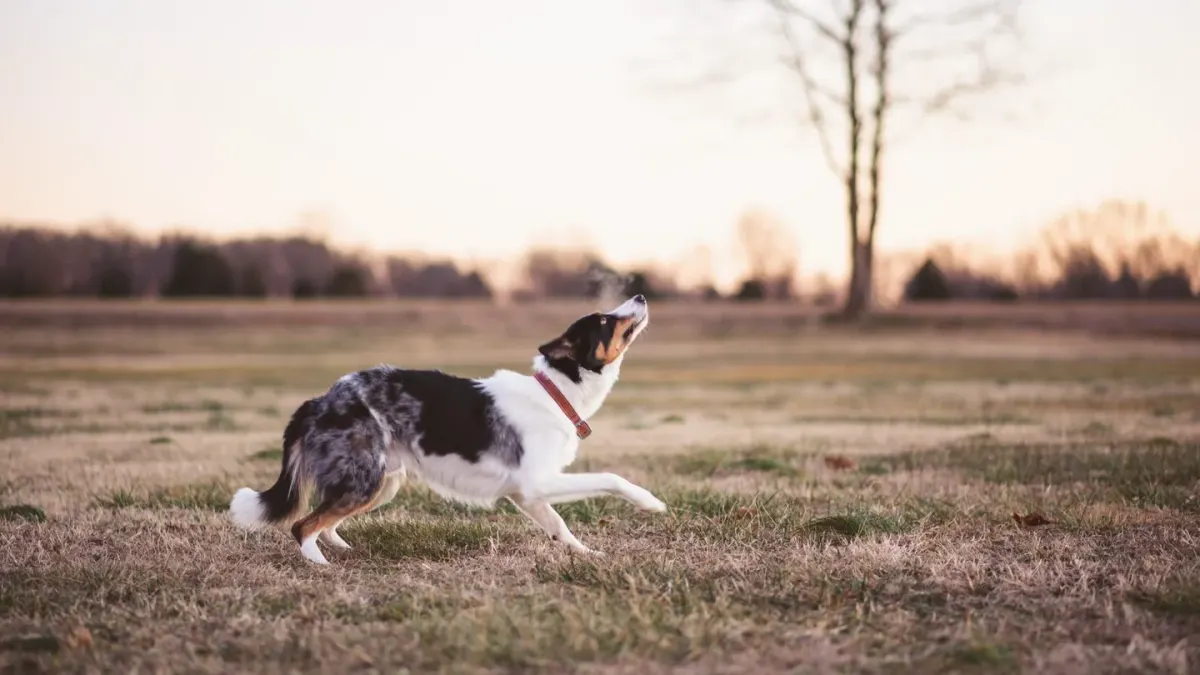
In my practice, the flirt pole comes up constantly with owners of working and herding breeds who’ve hit a wall on physical exercise. One case that’s stuck with me: a 3-year-old, 55-pound Australian Shepherd named Scout, whose owner had started doing flirt pole sessions in the backyard every evening after work, cutting sharp figure-eights across a small concrete patio to burn off Scout’s pent-up drive before dinner. Six weeks in, Scout started hesitating on stairs and slow to rise after naps — nothing dramatic, just a change the owner noticed because she was the one who fed him every night and knew his normal. What changed wasn’t the dog’s fitness; it was the surface and the turn pattern. Concrete doesn’t forgive a fast pivot the way grass does, and tight figure-eights ask the stifle to absorb load a straight sprint never would. Switching to a grass yard and wide, one-direction arcs, with the lure kept low, resolved the hesitation within a couple of weeks.
What a flirt pole is actually doing to a dog’s body
A flirt pole is a pole, a cord, and a lure — mechanically a giant cat toy scaled up for a dog’s stride and prey drive. The appeal for high-drive dogs is real: the moving lure engages the same chase-and-catch sequence that a walk never triggers, and that sequence is mentally as well as physically tiring in a way Wikipedia describes as designed to condition dogs for activities like lure coursing and to sharpen the skills used in that kind of competition.
That’s also where the risk sits. Rover recommends moving the lure in big, wide circles in one direction rather than zigzagging, warming a dog’s joints and muscles up before the session gets intense, and avoiding jerking or yanking motions that can strain the neck. None of that is boilerplate caution — it maps directly onto how connective tissue actually fails during hard-turn sports.
Warm up before you ever pick up the pole
Five minutes of loose walking or light trotting before a flirt pole session isn’t optional if you’re going to ask a dog to sprint and pivot at speed. Cold muscle and a cold cruciate ligament are a bad combination the moment a dog plants a paw to change direction. Treat the warmup the way you would before any interval workout: get blood into the muscles, let the dog’s stride open up gradually, and only then bring out the lure.
Running the session: technique matters more than intensity
Start slow. Let the dog see, hear, and track the lure at a walking pace before you add speed — this lets a dog learn the pattern rather than getting blindsided into a full sprint from a standstill. Keep the lure at or near ground level for the whole session; vertical jumping and mid-air catches are the highest-risk movement pattern for the joints, and there’s no version of a flirt pole game that requires the lure to leave the ground.
Move the lure in wide arcs, in one direction, rather than snapping it side to side. Tight, repeated changes of direction — the flirt pole equivalent of a figure-eight — are exactly where cruciate and stifle injuries tend to show up, particularly in larger dogs and dogs with any existing joint history. If you want your dog working hard, extend the arc and the distance rather than tightening the turns.
Surface counts too. Grass or a soft, non-slip surface gives a dog’s paws something to grip when they plant and pivot; concrete, tile, or hardwood takes that traction away right when the dog needs it most.
Reading your dog mid-session
A flirt pole can push a high-drive dog past the point where it’s still teaching self-control and into a state where the dog can’t hear you at all. Watch for excessive panting, a dog that stops responding to a “drop it” or “leave it” cue, or play that gets rougher than the dog’s normal baseline — those are signs to end the session, not push through it. Cap sessions at roughly 10 to 15 minutes, with water breaks built in, and stop while the dog is still tracking your cues rather than running purely on adrenaline.
Who should skip it, or wait
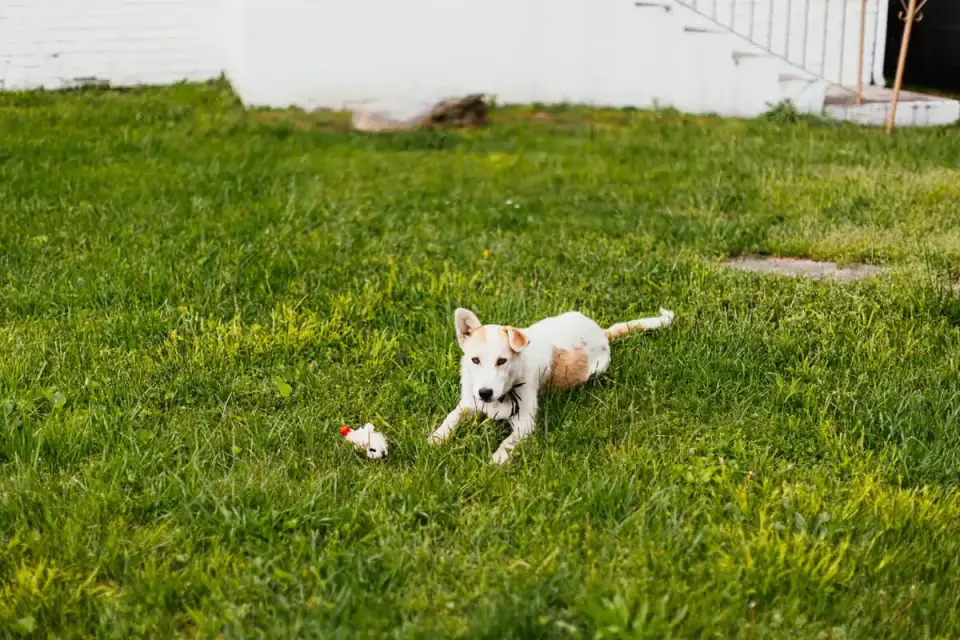
Puppies under roughly a year old are still growing bone and cartilage, and the kind of hard-stop, hard-turn play a flirt pole invites is a poor match for a developing skeleton — short, gentle sessions only, if at all, and never full-speed chasing. Dogs with a known orthopedic history — a prior cruciate injury, hip dysplasia, elbow issues, or a back problem — are exactly the dogs where a vet conversation should come before the first session, not after a limp shows up. K9 of Mine notes that a flirt pole isn’t the right tool for every dog, and that owners should watch for dogs who become so overstimulated they can’t calm back down, since that’s as much a training problem as a physical one.
A weekly flirt pole habit is one of several tools I’d weigh against a dog’s actual joint history before recommending it outright — not because the tool is dangerous by design, but because owners consistently underestimate what a tight turn does to a stifle at speed. For a young, structurally sound dog on grass, with wide arcs and a real warmup, it’s a legitimate way to burn off drive that a walk can’t touch. For an older dog, a dog recovering from injury, or a dog whose owner is running sessions on concrete, it’s worth scaling back before scaling up.
If you’re weighing a flirt pole against other high-output outlets — interactive toys versus chew toys is a useful comparison for matching the tool to the dog’s actual need — or you’re still building the basics of impulse control before you add a fast-moving lure into the mix, working through clicker versus verbal marker training first will make flirt pole sessions easier to control from day one.
One more scene that comes to mind: a client with a 2-year-old Belgian Malinois, high drive, zero joint history, who started flirt pole work three times a week specifically because his obedience-class recall had gotten sloppy from boredom. Within a month the dog was calmer at the door and easier to redirect on walks — not because the flirt pole fixed obedience by itself, but because it gave a dog with genuine unmet drive somewhere real to put it, which made every other training session land better. That’s the pattern I see most often: the tool works best paired with structure, not as a standalone fix.
Next step: if your dog has any joint history at all, run this by your vet before the first session — and if they’re cleared, start on grass, keep the lure low, and build up the arc before you build up the speed.
Frequently asked questions
How long should a flirt pole session last?
Most trainers recommend capping sessions around 10 to 15 minutes, with water breaks, and stopping earlier if your dog stops responding to cues.
Is a flirt pole safe for puppies?
Intense, full-speed flirt pole play isn't appropriate for puppies whose bones and joints are still developing; if you use one at all, keep sessions short, gentle, and low-impact.
What's the biggest injury risk with a flirt pole?
Sharp turns and vertical jumping are the highest-risk movements for joint injuries like cruciate ligament strain, especially on hard or slippery surfaces.
Sources
- How To Use a Dog Flirt Pole for Exercise & Bonding — Rover
- Flirt pole — Wikipedia
- Flirt Poles for Dogs: Store-Bought & DIY Flirt Poles! — K9 of Mine