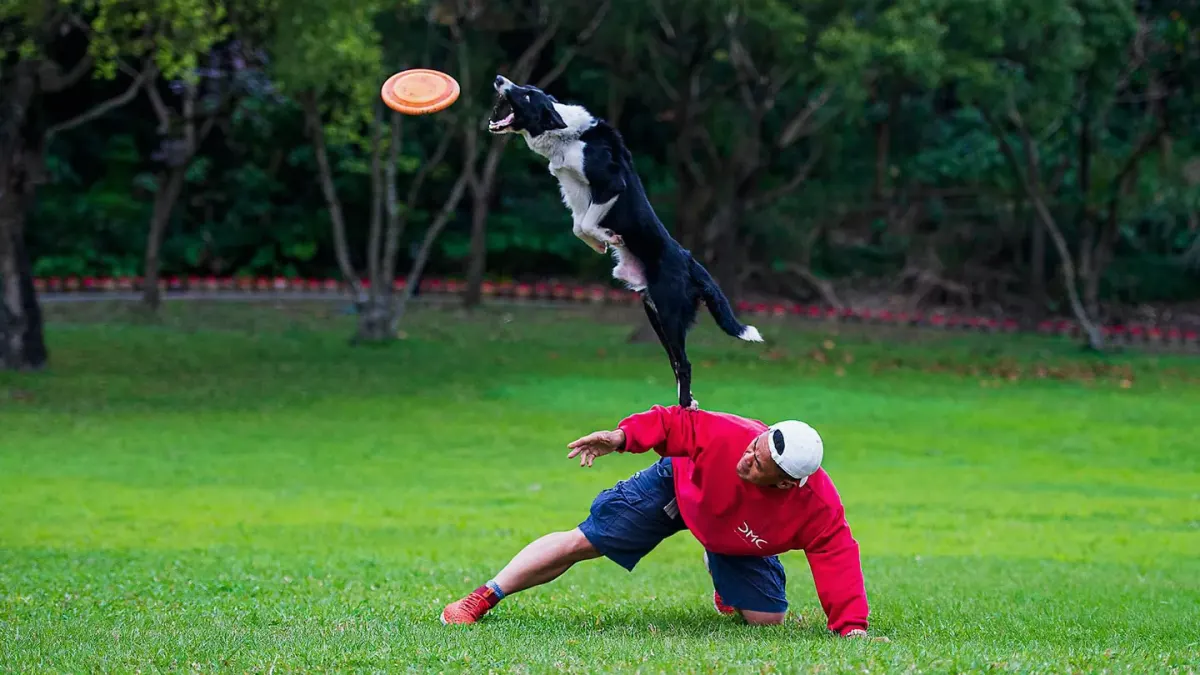
No — an automatic launcher is a supervised-fetch tool, not a solo toy. Leaving a ball launcher out sounds easy, but safe alone time needs a different plan.
A young adult herding mix, about 18 months old and 42 pounds, waits by the back door every workday morning while the owner debates the setup: load the hopper, plug in the automatic launcher, and let the dog self-exercise in the yard until lunch. The appeal is obvious on camera — the dog drops the ball, backs up, sprints after the launch. But by day three the pattern shifts. The dog stops waiting for the arc and starts crowding the muzzle, pawing at the chute, then chewing the damp tennis ball between launches for 40 minutes straight. The question is no longer whether the dog likes it, but whether that repetitive, high-arousal loop is doing what solo enrichment is supposed to do for joints, teeth, gut, and behavior.
Supervised fetch and solo play ask different things of the body
Fetch with a launcher is interval sprinting layered on arousal. Acceleration, hard deceleration, twisting catches, and repeated ball carrying load the forelimbs, neck, and lumbar spine, while panting and adrenaline blunt normal fatigue signals. From a sports-medicine view, that workload may help support conditioning when it is dosed — short sets, warm-up walk, rest breaks, appropriate surface — but it does not self-regulate well when no person is there to end the set.
Chewing physiology matters here too. Saliva softens the felt cover, jaw pressure compresses the ball, and a worn ball sheds fibers that are swallowed rather than spit out. The American Veterinary Medical Association advises choosing toys sized for the dog and supervising play with balls and squeak toys, removing damaged toys before pieces break off. That guidance fits launchers exactly: the machine keeps delivering the object your supervision would otherwise retire.

What I see go wrong when the machine stays on
A middle-aged retriever type left with a garage launcher for two afternoons learned to fish balls out of the hopper with his teeth. On the second afternoon, about six hours after the owner left, he was found drooling beside a ball chewed down to the rubber core, with retching but no vomit. Radiographs later showed a partial esophageal obstruction pattern that needed endoscopy, and recovery feeding took weeks to normalize. The failed approach was not the brand of launcher. It was assuming that more reps equal better exercise, when the unsupervised variables — ball condition, arousal, swallowing, heat, and fatigue — all moved the wrong way at once.
The Merck Veterinary Manual describes how foreign material can lodge in the esophagus, stomach, or intestines and cause obstruction, with signs including drooling, regurgitation, vomiting, anorexia, and abdominal pain. Balls are classic offenders because size, compressibility, and surface damage let a dog get further than expected before the object sticks.
Beyond ingestion, unsupervised launchers create three other failure modes I weigh heavily. Repetitive impact on hard patio or compacted dirt increases cumulative joint load without the muscle recovery that a nutrition and rehab plan is trying to build. Continuous play suppresses drinking and shade-seeking, which matters for brachycephalic breeds, dark-coated dogs, and any dog on a warm day — see our notes on Backyard Sprinkler and Splash Games for Hot Days for why water play still needs limits. And powered hoppers add pinch, tip-over, and cord-chewing hazards that do not exist with a Chew Toys vs. Edible Chews: What’s the Difference choice made for alone time.
Use the launcher only when you can watch the whole session.
When does the usual no-alone rule bend?
It bends for calm, low-possessive dogs whose owners want background motion without projectiles — and the answer is still not to leave balls in the machine. A senior terrier mix with early mobility stiffness, living in a one-bedroom apartment, did best on a different compromise across 14 nights of trial: launcher unplugged and put away before work, and a frozen food puzzle plus a sturdy rubber solo toy left instead. The owner kept launcher fetch to evenings, five throws on carpet with a walk warm-up, then put the balls in a closed bin. Nighttime pacing dropped from most nights to twice in two weeks, without the midday panting and ball-shredding the powered setup had produced.
That tradeoff clarifies my position. A supplement or food strategy may help support mobility and recovery, but it cannot offset hundreds of unsupervised sprints, and no launcher feature changes gut anatomy. If you want independent play while you are gone, choose designs meant for it, rotate them as described in Interactive Toys vs. Chew Toys: When to Use Each, and keep toys clean per How to Clean and Disinfect Dog Toys.
What would change my mind? Controlled data showing unsupervised launcher sessions do not increase ingestion events, overexertion, or arousal-related behavior problems compared with size-appropriate solo enrichment, across breeds and ages. Until then, the evidence-bounded call stays: play together, put it away apart.
So what should tomorrow look like if the workday is long and the dog still needs movement?
Sources
- Selecting Safe Toys for Pets — American Veterinary Medical Association
- Gastrointestinal Obstruction in Small Animals — Merck Veterinary Manual