On this page
Two options land on the table the moment the forecast turns bad: burn the dog’s energy some other way indoors, or accept a lower-output day and lean into mental work instead. Owners usually default to the first — tug, fetch down the hallway, stairs — because it looks like exercise. The second option is the one I actually reach for with most patients, and the reasoning is worth walking through before you commit either way.
In my practice, I’ve watched this play out with a seven-year-old Labrador named Otis, sixty-eight pounds, whose owner called in a mild panic during a three-day storm system last spring. Otis normally got a 45-minute off-leash session at a local field, and by day two indoors he was pacing the kitchen at 6 a.m. and mouthing the couch cushions — behavior his owner hadn’t seen since puppyhood. We didn’t reach for more indoor fetch, which was already making him pant and overheat in a small apartment. Instead we built a 15-minute scent-search routine before breakfast: kibble scattered across three rooms, then a snuffle mat for the last portion. By day three, Otis was sleeping through the early morning instead of patrolling it, and the cushion-chewing stopped. That’s one dog’s response, not a guarantee, but it’s the pattern I look for when a dog’s normal outlet disappears.
Physical substitutes versus mental substitutes
The instinct to replace a walk with indoor running games makes sense on paper — a tired dog is a tired dog, regardless of how the fatigue was earned. In practice, most apartments and living rooms don’t have the square footage to replicate real cardiovascular output, and repeated fetch on hard flooring adds joint load without much aerobic payoff for an adult dog. Stairs work better than flat-floor fetch for sheer output, but they’re rough on dogs with any early joint sensitivity, and they don’t touch the boredom piece at all.
Mental substitutes solve a different problem. A scoping review of scent activities for canines, published in Applied Animal Behaviour Science, found that structured scent work is consistently associated with improved welfare indicators and calmer behavior in the dogs studied — which lines up with what I see clinically: a short, focused sniffing session tends to settle a dog faster than an equivalent stretch of indoor running. The honest caveat is that scent work doesn’t build cardiovascular fitness or muscle tone the way a hike does, so it’s not a full substitute for dogs that are also missing structured physical conditioning over a longer stretch of bad weather.
What actually fills the gap, activity by activity
- Snuffle mats and scatter-feeding: turns a meal into 10–15 minutes of foraging behavior; low arousal, good for anxious or older dogs.
- Hide-and-seek with a stay: cheap, no gear, works the dog’s recall and scent-tracking together.
- Puzzle feeders: best for food-motivated dogs; skip if your dog gets frustrated and abandons the toy, since that can build negative associations instead of confidence.
- Structured tug or flirt-pole in a hallway: genuine physical output in a small footprint, but only for dogs with sound joints and good bite inhibition.
- Basic obedience refreshers: five to ten minutes of sit-stay-recall drilling is mentally taxing for a dog that hasn’t done it in a while, and it costs almost nothing in physical wear.
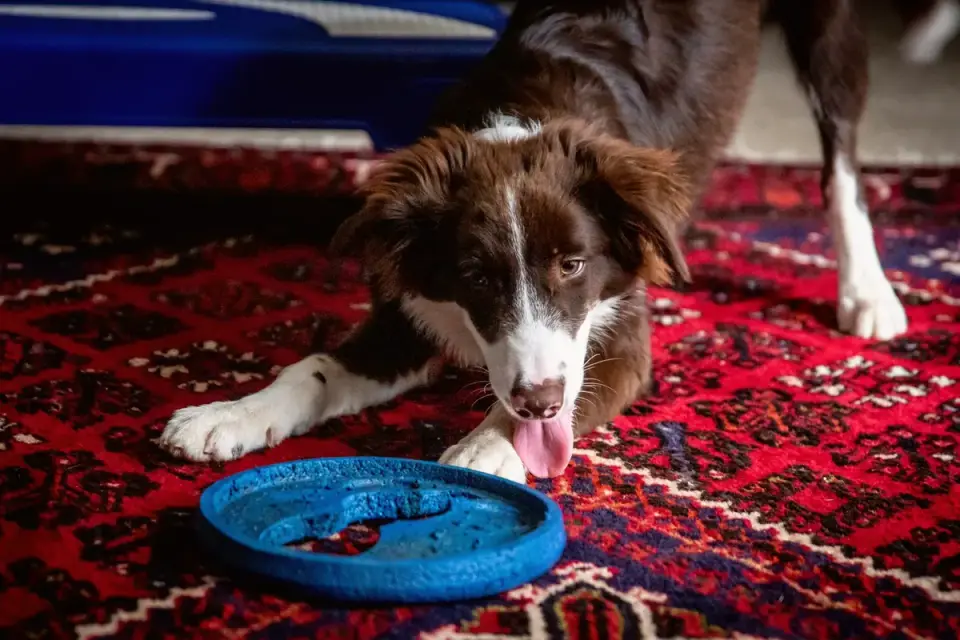
For Preventive Vet: nose work games, the setup barely matters — a muffin tin, a cardboard box maze, or three rooms of scattered kibble all trigger the same foraging drive. What matters more is consistency: a dog that’s never done scent work will need a slower introduction than one who already knows the game.
Reading which one your dog actually needs
A young, physically fit dog missing several days of real exercise — the kind who’d otherwise be doing the distances covered in how far a dog can hike in a day — is going to need some physical outlet regardless of weather, even if it’s just structured tug or stairs in short bursts. An older dog, or one recovering from a joint issue, is often better served skipping the physical substitute entirely and leaning into scent work and puzzle feeding, since those tax the brain without loading the joints.
One short note on treats: whatever you’re scattering for scent games, keep it to the dog’s normal diet or approved treats. This is not the day to experiment with new table food — a dog stuck indoors with a stormy stomach is worse than a dog stuck indoors with a stormy sky, and foods like apples need the seeds and core removed before they go anywhere near a snuffle mat.
One of the dogs I worked with for years, a nine-year-old terrier mix named Biscuit, taught me how much this decision depends on the individual dog rather than a general rule. Biscuit had mild hip changes and a low tolerance for boredom in roughly equal measure, and her owner initially tried to solve rainy days with more indoor fetch because that’s what had always worked for a younger, healthier version of the same dog. Within two days of a wet week, Biscuit was limping slightly after each session and still restless at night. We swapped the fetch for a rotation of scatter-feeding, a slow-intro puzzle feeder, and short obedience drills, and her owner reported normal sleep and no limping by the second day of the new routine. The gait change and the restlessness were both markers worth tracking — not proof of anything on their own, but useful signals in a dog whose exercise needs had quietly shifted with age.
Where I land
I don’t tell owners to pick one lane and stay there. The dogs who do best on a run of bad-weather days get a rotation: a short scent or puzzle session in the morning, a structured five-to-ten-minute physical burst mid-day if the dog’s joints and age allow it, and a calmer obedience refresher in the evening. That mix covers the brain and the body without asking a small indoor space to do the job of a field or a trail. Once the weather clears, that same dog is usually more, not less, ready for a real outing — whether that’s a proper hike or an afternoon at one of the dog-friendly patios that reopen the routine.
Frequently asked questions
Is 15 minutes of scent work really equivalent to a walk?
Not in cardiovascular terms — a scent session doesn't replace aerobic exercise. But it does produce a comparable level of mental fatigue for many dogs, which is why a short foraging or nose-work session can settle a restless dog faster than more indoor fetch.
What if my dog just gets more wound up during indoor games?
That usually means the game is too high-arousal for the moment. Swap active games like tug or fetch for lower-arousal foraging activities like scatter-feeding or a snuffle mat, and keep sessions short.
Sources
- The value of sniffing: A scoping review of scent activities for canines — Applied Animal Behaviour Science (ScienceDirect)
- Nose Work: Games and Training Tips for Scent Work — Preventive Vet