On this page
- Quick answer before we get into the weeds
- The decision fork: what is this harness actually crossing?
- What I see in the exam room
- What the research actually shows about shoulder restriction
- Where each shape earns its keep
- Collar comparison matters here too
- How to actually check the fit, step by step
- Where a fitted harness fits into the rest of the walk kit
- The bottom line
Quick answer before we get into the weeds
- Check where the front strap sits. If it crosses flat over the top of the shoulder blade, that’s the sign to worry about, regardless of whether the harness is marketed as Y or H shaped.
- Y-shaped harnesses generally leave more room around the point of the shoulder, which is why they’re the default recommendation for dogs who move a lot — sport dogs, long walkers, dogs still building leash manners.
- H-shaped harnesses add a horizontal chest strap and a back strap, which spreads pulling force over a wider area and tends to feel more stable on dogs who lean into the leash or need extra control on a slippery sidewalk.
- Neither shape is automatically “safe.” A poorly sized Y harness can still choke off shoulder movement; a well-sized H harness can still be comfortable. Fit beats label almost every time.
- Brachycephalic breeds (French Bulldogs, Pugs, Boston Terriers) should be in a harness of either shape rather than a collar, because of what collar pressure can do to airway structures.
Now let’s talk about why that checklist holds up, and where it doesn’t.
The decision fork: what is this harness actually crossing?
Every harness question I get boils down to one thing: what part of the dog’s body does the strap cross, and does that spot move when the dog moves? The shoulder blade — the scapula — rotates and glides against the ribcage with every stride. A strap sitting directly over that gliding surface interferes with the stride in a way a strap sitting behind or below it doesn’t.
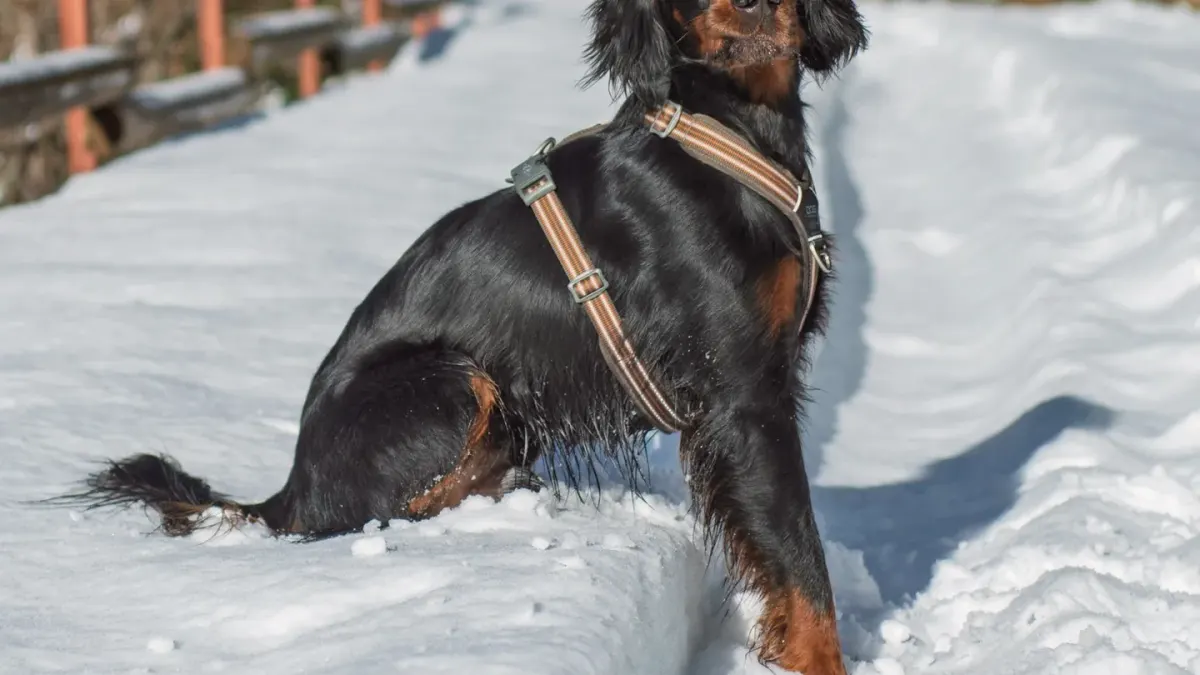
A Y-shaped harness is built around a V of webbing that meets at the sternum and runs up and over each side of the neck, theoretically staying above and in front of the point of shoulder rather than pressing across it. An H-shaped harness swaps that V for a straight horizontal chest strap connected to a back strap, forming the H when you look at it from the side. That chest strap sits lower and flatter across the front of the chest, which is where the fit debate actually starts.
What I see in the exam room
In my practice, the dogs I worry about aren’t the ones in a “wrong” harness — they’re the ones in a harness that was sized for a different dog. I had a client bring in Otis, a three-year-old Boxer, about eight months after she’d bought him a Y-front harness off a big-box shelf without measuring his girth first. She’d noticed he’d started skipping steps on stairs and seemed to hesitate before jumping into the car, which she chalked up to “getting lazy.” When I watched him walk across the room, his right front stride was visibly shorter than his left. The chest strap had been cinched a size too small, and instead of sitting above the shoulder the way a Y-front is designed to, it had ridden down and was catching the front edge of his scapula on every reach. We resized him into a properly fitted harness, and within a few weeks the owner reported he was clearing the tailgate again without the hesitation. That case is the reason I never tell an owner “just buy a Y-shaped harness” without also telling them how to check the fit.
What the research actually shows about shoulder restriction
This is the part that surprises people: the Y-shape isn’t automatically the gentler option once you look at gait data instead of marketing copy. A gait-restriction study measuring shoulder extension found that a straight chest-strap harness reduced shoulder extension by up to 8 degrees, while a Y-shaped harness — the kind commonly marketed as non-restrictive — reduced shoulder extension by up to 10 degrees during the same walk and trot testing, as reported in the Four Leg Rehab: study on restrictive harnesses and shoulder extension. The authors noted the Y-front webbing can still press against the musculature around the cranial angle and border of the scapula even when it isn’t crossing the joint directly.
That doesn’t make the H-shape the winner by default. A separate gait-analysis method built specifically to evaluate harness design, published in PLOS One: Development of a detailed canine gait analysis method for evaluating harnesses: A pilot study, found that harness design meaningfully changes stride mechanics and argued that fit and strap placement need to be measured on the individual dog rather than assumed from the harness category. Put plainly: both shapes can restrict a shoulder if they’re sized wrong or sit in the wrong spot, and the label on the box tells you less than five minutes of watching the dog walk in it.
Where each shape earns its keep
A Y-shaped harness tends to be the better call for dogs doing a lot of forward, reaching movement — agility, long-distance walking, dogs still growing into their gait. The narrower chest contact point means less total fabric across the front, which matters for a dog whose stride you don’t want to shorten.
An H-shaped harness earns its place with dogs who need more surface area for control: a dog who leans hard into the leash, a senior dog who benefits from a sturdier back-strap handle for stability on stairs, or a dog whose chest conformation makes a Y-front ride up into the throat. The wider chest band in an H design distributes pulling force instead of concentrating it at one point, which some owners find reduces chafing on long walks.
Collar comparison matters here too
If you’re weighing either harness shape against a plain collar, the harness wins on airway safety in almost every case, not just for brachycephalic dogs. Research comparing collars and harnesses in both brachycephalic and dolichocephalic dogs found measurable increases in intraocular pressure and changes in respiration rate when dogs wore a collar rather than a harness, detailed in PMC (National Institutes of Health): Effect of a Collar and Harness on Intraocular Pressure and Respiration Rate of Brachycephalic and Dolichocephalic Dogs. That’s one more reason I default clients with flat-faced breeds, or any dog with a history of coughing on leash, straight to a harness conversation rather than debating collar brands.
If your dog also rides in the car, a harness that fits well at the shoulder is only half the safety picture — you still want it anchored correctly for travel; our guide on how to secure a dog crate in the car covers the other half of that setup.
How to actually check the fit, step by step
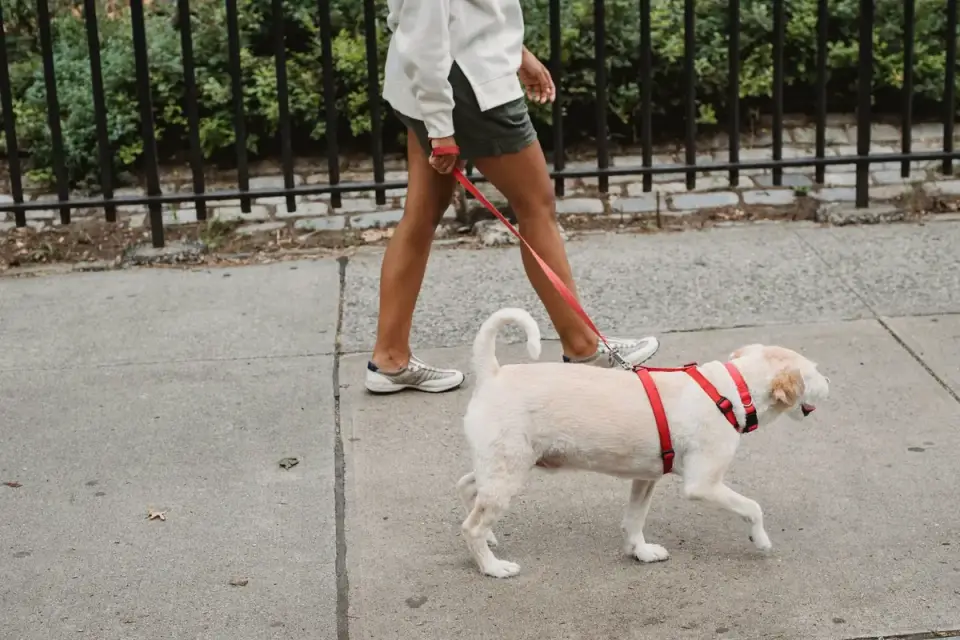
Put the harness on and run two fingers flat under every strap — you should slide them in without force and without slack. Then watch the dog walk, not just stand. Have them trot a few steps on a hard floor and look at the front legs from the side: if one stride looks visibly shorter than the other, or the dog seems to be pulling a leg in rather than extending it forward, the strap is sitting somewhere it shouldn’t.
Check the girth strap sits a finger-width behind the front legs, not jammed into the armpit. On a Y-front, confirm the V meets at the breastbone and the straps run up the sides of the neck rather than across the top of the shoulder blade. On an H-front, confirm the horizontal strap sits below the point of the shoulder, not across it.
Where a fitted harness fits into the rest of the walk kit
A harness that fits is one piece of a leash setup, not the whole thing. If you’re working with a dog who pulls or lunges, how the leash itself is built matters just as much as harness shape — see our breakdown of what a double-ended leash is for for how the two work together. And if the dog you’re fitting is more of an escape artist than a puller, harness fit alone won’t solve that; our guide to GPS trackers for a dog that runs off covers the backup layer worth adding.
The bottom line
I’ve come around to the same answer I give in the exam room: don’t shop by letter shape, shop by strap placement and then verify it on the actual dog. A Y-shaped harness is the better starting point for most active dogs because the design intent is to clear the shoulder, but the research is clear that intent and execution aren’t the same thing — a mis-sized Y-front can restrict a stride as much as an H-front does. If you’ve got a dog with a deep or barrel chest, a senior dog who needs more support, or a strong puller, don’t rule out the H-shape just because it isn’t the trendier option. Fit it, walk the dog in it, and let the gait tell you whether it’s working. Going forward, I’d rather owners leave a fitting with a two-finger check and a trot test than a strong opinion about which letter is better.
Frequently asked questions
Is a Y-shaped harness always better than an H-shaped harness?
Not always. Y-front harnesses generally leave more room around the shoulder, but research on shoulder extension shows a poorly fitted Y-harness can restrict movement as much as, or more than, a well-fitted H-harness. Fit matters more than shape.
Which harness shape is better for a dog that pulls hard?
H-shaped harnesses tend to feel more stable for dogs who lean into the leash, since the wider chest strap and back strap spread the pulling force over more surface area.
Are harnesses safer than collars for brachycephalic dogs?
Yes. Studies on brachycephalic and dolichocephalic dogs have found collars increase intraocular pressure and affect respiration rate more than harnesses do, which is why harnesses are generally recommended for flat-faced breeds.
Sources
- Restrictive Harnesses on Shoulder Extension in Dogs at Walk and Trot — Four Leg Rehab
- Development of a detailed canine gait analysis method for evaluating harnesses: A pilot study — PLOS One
- Effect of a Collar and Harness on Intraocular Pressure and Respiration Rate of Brachycephalic and Dolichocephalic Dogs — PMC (National Institutes of Health)